
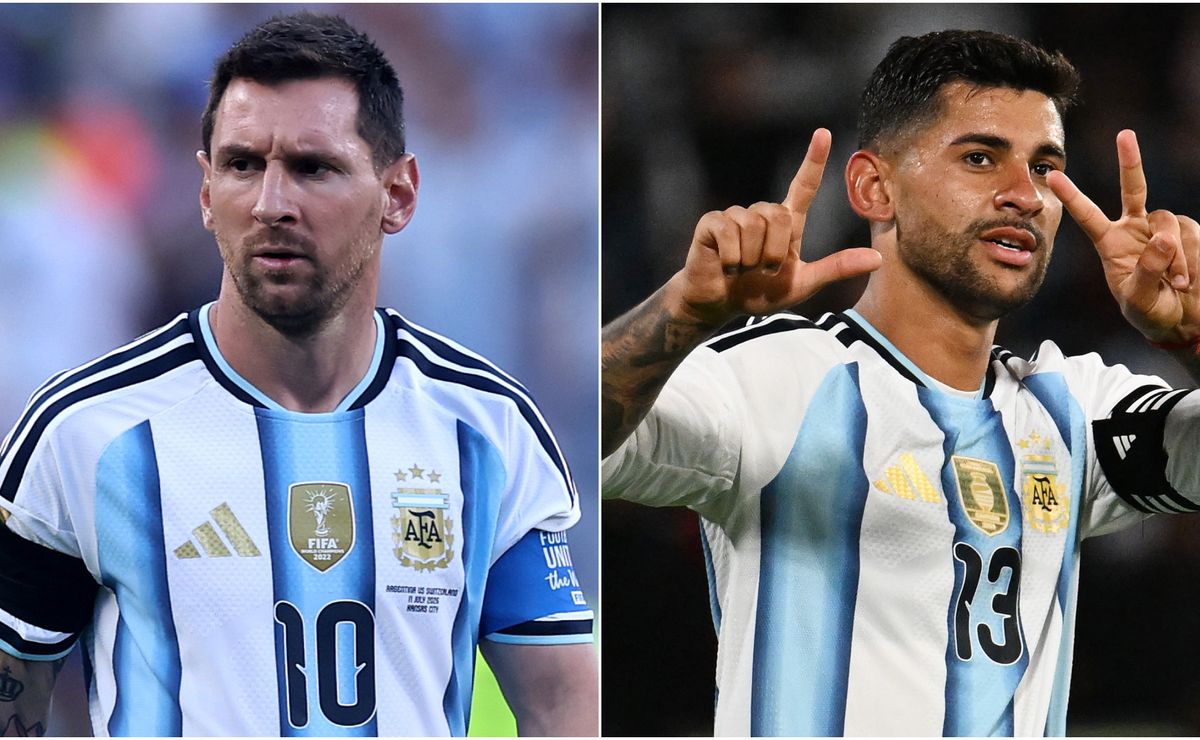
Argentina captain Cristian Romero has named the player he believes should inherit Lionel Messi’s No. 10 shirt after the star’s international retirement. Argentina are still searching for the player who will inherit one of the most iconic shirts in world football. Since Lionel Messi retired from international soccer, the question of who will wear the No. 10 has remained open, and new captain Cristian Romero has now weighed in with an answer of his own.
Speaking in an interview with the YouTube channel Los Edul, the defender named Atletico Madrid teammate Julian Alvarez as his choice to take over the shirt. Romero explained that his pick goes beyond football ability. “I see him with that profile of humility, family man, good kid. He has the qualities, I think it’s him,” he said, adding: “We have many very important players in the national team. I say Julian because I see all those things that are important to wear the 10“.
Key Developments in Cristian Romero picks Lionel
Romero did admit that his first idea would be different. “I would put it aside, put a mural up at AFA and that’s it, so that nobody has that responsibility,” he said, before accepting that it is not an option and saying he would give it to Alvarez.
The captain also revealed that he has already brought it up with the forward more than once, but that the player does not seem convinced. “I think he would like to wear it. I’ve told him many times, but he wants to keep his own,” Romero said.
Post-Match Reactions and Strategic Impact
Nico Paz is the other name emerging as a frontrunner for the No. 10. Local reports have pointed to the Como midfielder as the favorite to receive the shirt. However, no official decision has been announced, and Romero’s words show that the choice remains open.
Argentina cannot retire the No. 10 jersey
Romero’s idea of putting the shirt aside runs into a hard regulatory wall. FIFA rules require official squad lists for tournaments such as the World Cup and Copa America to use consecutive numbering from 1 to 26, with a number assigned to every player named to the roster.
That means the No. 10 cannot simply be left unused in official competition, no matter how symbolic the gesture would be. The number could theoretically go unused in a friendly, but in any official tournament, someone on the 26-man list would have to wear it.
It would not be the first time Argentina run into this obstacle. Ahead of the 2002 World Cup, the country tried to retire the No. 10 as a tribute to Diego Maradona, whose career had already cemented the number’s legendary status.
FIFA rejected the request outright, citing the same consecutive-numbering rule that stands in the way today. As a result, the shirt continued to be worn by later generations of Argentine players, eventually passing to Messi himself.
Tactical Telemetry and Strategic Analysis in Cristian Romero picks Lionel
The tactical parameters underpinning this Football encounter revealed critical nuances in structural discipline and transitional efficiency. Both teams engaged in deliberate phase-building, seeking to exploit microscopic positional imbalances across high-leverage sectors of the playing surface. Analytical telemetry indicates that ball retention in contested half-spaces proved decisive in dictating the overall tempo, forcing opposing units to continuously reshuffle their defensive blocks.
Furthermore, tactical adjustments implemented during critical intervals altered the trajectory of play. The technical staff's emphasis on rapid recovery phases and controlled territorial progression disrupted opponent rhythm, ensuring that high-pressure phases yielded tangible competitive advantages rather than passive defensive consolidation.
Championship Ramifications and Forward Calendar
Beyond the immediate outcome, this result carries profound consequences for championship trajectory and upcoming fixtures across Football. Technical departments from both camps now face crucial analytical debriefs, dissecting individual duel success rates and physical workload metrics to calibrate training cycles for the grueling calendar ahead.
With subsequent rounds promising heightened intensity, the ability to maintain composure during decisive match phases will remain the ultimate benchmark. As fixtures accumulate, physical resilience and tactical versatility will dictate which organizations consolidate their status at the summit of elite competition.